| Name | Menina Mountain |
| Full Address | Slovenija, Gorenjska, Menina planina, pri Tuhinjski dolini |
| Koordinate | 46.25, 14.8166 |
| Spletna stran/vir | visit site |
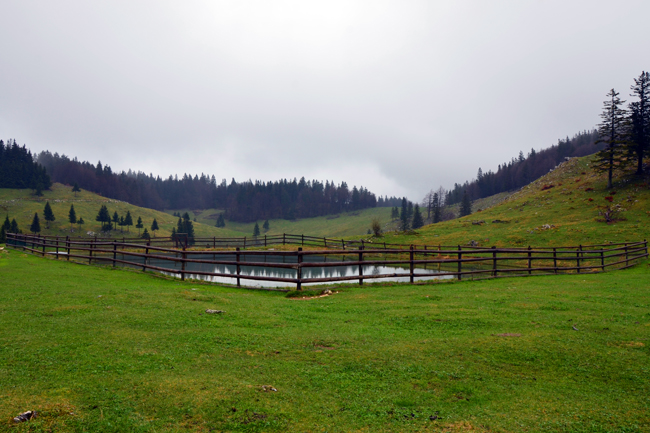
Natural Gems of Slovenia: Menina Plateau The vast, forested karst plateau of Menina lies at an altitude of approximately 1,200–1,500 meters in the eastern part of the Kamnik-Savinja Alps, among the plateaus in central Slovenia, and promises beautiful panoramic views of the rocky chain of peaks. Menina Planina is a vast mid-mountain karst plateau. It is bordered by the Tuhinj Valley to the south, the Črnivec Pass to the west, the Dobroveljsko Plateau to the east, and the Gornjegrajsko Basin to the north. Numerous roads lead to Menina Planina, providing hikers with easy access to the vicinity of the peaks and other destinations. Several marked trails lead to the summit, where the mountain hut is located, from the Drete Valley and the Tuhinj Valley. The trails mostly run through the forest; they are quite long and do not offer the best views. It was named after the monks from the Gornji Grad monastery, to whom it once belonged. Below Menina Planina, in the Gornji Grad Basin, in the foothills of the Kamnik-Savinja Alps, lies Gornji Grad. The Dreta River flows through the valley, emptying into the Savinja at Nazarje. The valley’s settlement pattern features scattered settlements with a defined center on the flat part of the basin and isolated farms scattered across the hills. Gornji Grad is the largest settlement and administrative center of this largely agricultural region, marked by significant historical and cultural monuments. It was once the seat of the Diocese of Ljubljana, and today the town boasts the largest cathedral in Slovenia. Gornji Grad is also a wonderful starting point for a hike to Menina Planina. The trail is well-marked with trail markers and signposts. 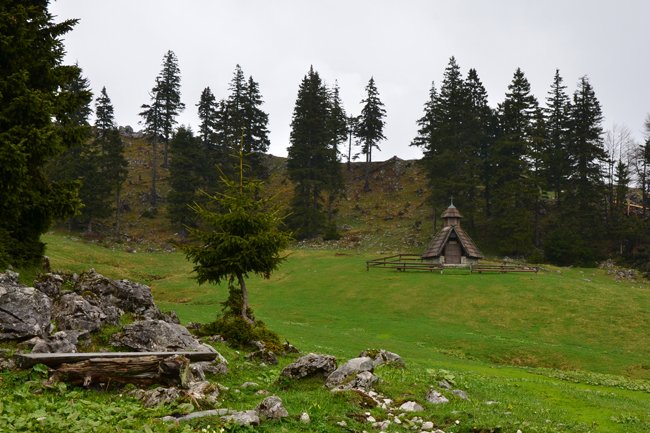 photo: Barbara Debeljak From the highest peak (Vivodnik, 1,508 m), there is a magnificent view of the central part of the Kamnik-Savinja Alps. Amid the undulating karst landscape, where grasslands alternate with increasingly dominant forests. The observation tower lifts us above the forest and rewards us with a view. The second most frequently visited area is Šavnice, with its highest peak, Goli vrh, in the southern part of the plateau, where the elevation is slightly lower but the surface is not overgrown. On Goli vrh, we can also see alpine herbs, which, despite the proximity of the Alps, are not very common on Menina. The plateau is most populated in the summer, when livestock grazes here. Menina Planina is still important for livestock grazing, although the number of animals has now decreased and some grassy areas are being overgrown by forest. Most of the area, except for the area around the panoramic Golem vrh, is overgrown with forest, which regenerates quickly once grazing ceases. Alongside Velika planina, it was once the second-largest pastoral settlement in the Savinja Alps. Lake Biba lies in a basin in the northeastern part of the plateau. It formed on a patch of impermeable shale. However, shepherds likely also sealed the porous karst bottom, as water for livestock is essential for grazing. Lake Biba is a modest yet important water source for livestock grazing on Menina. The pond, approximately 90 meters long and 50 meters wide, is a natural monument. Its size depends on the amount of rainfall. In the northern part of the plateau lies Jespa Cave. The ice cave is located near the Menina Mountain Hut, at the northern end, between the main peak of Vivodnik and the northern edge of the plateau. The entrance to the cave is at the bottom of a 30-meter-deep karst sinkhole, which is accessible via a trail. The descent to the bottom requires some easy climbing. The trail safely leads us to the bottom, and as we descend, we clearly feel the temperature drop significantly. The cave is characterized by thermal and vegetation inversions. A thermal inversion, or temperature inversion, is a phenomenon also found in caves in the Kočevje region, the Trnovski Forest, Snežnik, or larger depressions in the Notranjska region and the Karst. The temperature difference is also reflected in the vegetation, as subalpine vegetation has developed in the lower sections. In the southern part of the cave, there are several passages with icefalls. This magnificent cave is also famous for its cave beetles. Various karst phenomena are common on Menina Planina. The higher parts of the area generally have scarce surface water, while springs are common at their foothills. Today, we all too often forget that we live in one of the most beautiful corners of our planet, which is full of natural gems. Menina Planina is certainly one of them. Cover photo: Barbara Debeljak
We verify details against official sources and structure them as a practical guide. Always reconfirm changing information with the operator.
Help us keep this guide accurate. We verify every report before updating the page.